


A Guide to Wedding Day Transportation Timing
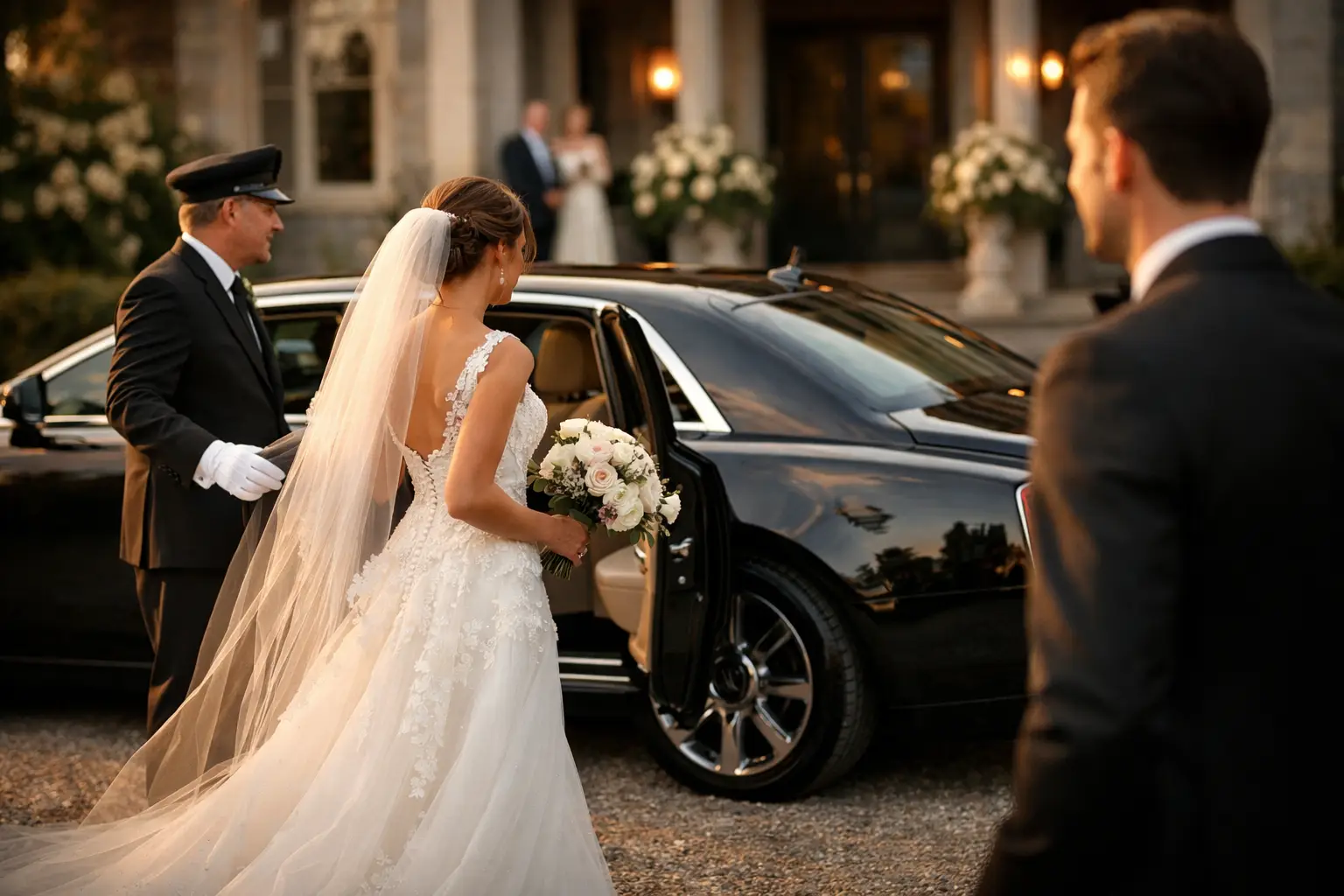
The transportation timeline usually breaks down in the same place: the couple plans the ceremony to the minute, then treats travel as if roads, loading, family photos, and outfit adjustments will cooperate on command. They rarely do. A solid guide to wedding day transportation timing starts with one rule: the drive itself is only part of the schedule.
For weddings across Toronto, Mississauga, Brampton, Vaughan, Markham, Hamilton, and beyond, timing needs to account for elevators, venue access, photographers, grandparents, children, formalwear, and the fact that one late pickup can push everything behind. If you are moving a couple, bridal party, and family members across more than one location, transportation is not a side detail. It is part of the day’s operations.
Why wedding transportation timing goes wrong
Most delays are not caused by distance. They come from transitions.
A five-minute delay at the hotel lobby becomes fifteen when the bride is still stepping into the dress, the photographer wants a few indoor shots, and the family starts asking which vehicle they are assigned to. The same thing happens after the ceremony. Guests linger, receiving lines run long, and nobody wants to be the person cutting off hugs so the convoy can leave.
Traffic also matters, but not in a generic way. Downtown church ceremonies, suburban banquet halls, and estate venues all create different timing issues. A church in a dense urban area may require extra time for loading and parking coordination. A countryside venue may need more drive time plus a few extra minutes for gravel entrances, long walk-ups, or remote photo locations. A good schedule respects both the route and the reality on the ground.
Guide to wedding day transportation timing by event phase
The easiest way to build a working timeline is to schedule backward from the ceremony start time.
Getting ready pickups
For the first pickup of the day, build in more buffer than you think you need. Hair and makeup delays are common. So are missing jewelry, misplaced bouquets, and last-minute steaming. If the couple is leaving from separate locations, each address should have its own realistic departure window instead of one broad pickup time for everyone.
As a rule, the vehicle should arrive before the planned departure time, not at it. That gives the chauffeur time to position the vehicle, confirm names, and load the party properly. It also gives the photographer a few minutes for departure shots if those are part of the plan.
If the bride is wearing a fuller gown or a long veil, boarding takes longer. The same applies to a vintage vehicle such as a 1960 Rolls-Royce Silver Cloud II, where entry and exit require a little more care than a larger SUV. That is not a problem, but it does change timing.
First look and photo stops
This is where many timelines become too optimistic. Couples often assume photo locations will take the exact amount of time the photographer estimated, with no allowance for travel, regrouping, weather adjustments, or restroom breaks.
If you have a first look, wedding party photos, and family portraits before the ceremony, transportation should be planned around those segments as separate movements. Do not treat it as one simple drive from the hotel to the ceremony. In practice, it may be hotel to photo site, photo site to second photo site, then second site to ceremony venue.
Each move needs loading time on both ends. A Rolls-Royce Ghost or Mercedes-Maybach S 580 for the couple may move quickly, but a Sprinter or stretch limousine carrying a larger group simply takes longer to board and unload. The bigger the group, the more conservative the timing should be.
Ceremony arrival
The target is not to arrive exactly at ceremony start time. The target is to have the right people on site, composed and ready, well before guests notice any tension.
For the couple, that usually means arriving early enough for touch-ups, lineup coordination, and any religious or cultural preparation that happens just before the ceremony. For family members, it means avoiding a rushed entrance that distracts from the moment.
This matters even more for multicultural weddings. A Hindu ceremony tied to a specific muhurat may leave less flexibility than a typical banquet schedule. A Sikh or Punjabi wedding may involve timing around the baraat and groom’s arrival. A Persian ceremony with a Sofreh Aghd setup may require careful coordination between arrival, room access, and photography. A Chinese tea ceremony often adds another location and another transition that must be timed properly, not squeezed in as an afterthought.
How much buffer should you actually build in?
There is no universal number because wedding logistics depend on city, season, vehicle type, and guest count. Still, one principle holds up every time: short drives need proportionally larger buffers than people expect.
A fifteen-minute drive should not be given a fifteen-minute schedule. It needs room for loading, traffic lights, photo interruptions, and the possibility that one person is not ready when everyone else is. Longer transfers also need buffer, but they are usually planned more carefully because the risk is more obvious.
The safest timelines separate drive time from event time. If photos are booked for forty-five minutes, keep those forty-five minutes for photos. Do not quietly borrow ten of them for boarding and then another ten for parking and walking in. That is how the day starts slipping.
Choosing the right vehicle affects timing
Transportation timing is not only about the route. Vehicle choice changes how fast a group can move.
A Rolls-Royce Phantom, Ghost, or Cullinan is ideal for the couple because the boarding process is controlled and the visual arrival matters. A Cadillac Escalade, Chevrolet Suburban, or GMC Yukon XL works well for immediate family when you need easy entry, comfort, and room for formalwear. Larger bridal parties or family groups often move better in a Mercedes Sprinter Limo Style, Mercedes Sprinter Corporate, or Ford Transit because everyone stays together and the coordinator is not chasing separate arrivals.
Stretch limousines and party buses have their place, but they require disciplined scheduling. Larger vehicles can take longer to position at hotels, churches, and busy banquet halls. If the plan involves a convoy, it helps to keep pickup points simple and avoid unnecessary stops.
This is one reason professionally managed chauffeur service matters on wedding days. When every vehicle is company-owned and every chauffeur is a direct employee, dispatch has better control over staging, communication, and adjustments as the day unfolds. That consistency is often what protects the timeline when conditions change.
A realistic guide to wedding day transportation timing for multi-location weddings
Multi-location weddings need a written movement plan, not just a start and end time.
If the day includes separate getting-ready sites, a church ceremony, a park or waterfront photo stop, and a banquet hall reception, each segment should be mapped with an arrival target and a departure target. Not a rough guess. A real time.
It also helps to identify who must be in which vehicle. The couple’s car should not be delayed because a family member assumed they were riding in it. The bridal party should not be split in a way that creates two different arrival times unless that is intentional. Grandparents and elders may need easier-access SUVs instead of lower-profile vehicles, and that should be decided ahead of time, not at curbside.
Reception timing deserves the same discipline. Guests usually focus on the ceremony, but the move to cocktail hour or the reception entrance can be just as sensitive. If the couple is taking extended photos after the ceremony, someone should account for where the family goes, how the wedding party travels, and when the main arrival is expected at the hall.
What to confirm with your transportation provider
A few details matter more than people realize. Confirm the full address for every stop, the order of service, contact names for the day, and whether there are any restrictions for access or parking. If a venue has one narrow entrance or a church only allows loading from a side lane, that should be known in advance.
You should also confirm the actual vehicle plan, not just the booking category. A wedding timeline works better when everyone knows whether the couple is in a Phantom Two-Tone, a Cullinan, or a Maybach S 580, and whether the family is moving in a Sprinter, Escalade, or stretch limo. Capacity, dress volume, and boarding speed all change with the vehicle.
Flat-rate pricing also helps with planning because the route and service window are defined before the day begins. That removes the distraction of per-mile thinking and keeps the conversation where it belongs: on timing, routing, and execution.
The smartest transportation timeline is usually the calmer one
Couples often want to fit in one more stop, one more photo location, one more surprise entrance. Sometimes that works. Sometimes it creates a timeline so tight that nobody enjoys the ride.
The better approach is to protect the key moments and leave room around them. If the ceremony matters most, guard that arrival. If portraits matter most, give them proper time and reduce unnecessary movement. Wedding transportation works best when the day has shape, not when every minute is spoken for.
A well-built timeline does not feel slow. It feels controlled. And on a wedding day, that control is what gives everyone room to actually be present.


Leave a Reply