

A delayed pickup can affect far more than one meeting. It can leave a visiting executive waiting at Pearson, split a leadership team between vehicles, or put an investor dinner behind schedule before anyone reaches the table. Corporate transportation is not simply about choosing a sedan or SUV. It is an operational decision involving timing, passenger count, luggage, privacy, route planning, and a clear point of contact.
For Toronto businesses, the right arrangement depends on the day ahead. A Bay Street executive traveling alone has different requirements from a legal team moving between offices, a group arriving for a conference, or international visitors landing at a private aviation terminal. The details should be settled before the chauffeur arrives, not improvised at the curb.
What Corporate Transportation Should Accomplish
A corporate car service should give an office manager, executive assistant, or traveler a practical answer to a basic question: how will everyone get where they need to be, on schedule and with the right level of privacy? That starts with a confirmed itinerary, passenger details, pickup locations, flight information when relevant, and vehicle assignments that fit the group.
A formally dressed, licensed chauffeur also changes the nature of the service. The traveler is not responsible for navigation, parking, fuel, or coordinating a return pickup while preparing for a meeting. For clients handling confidential calls or reviewing material between appointments, a chauffeur-driven vehicle creates useful time rather than another task to manage.
Reliability is more than a stated pickup time. It includes allowing for traffic patterns, airport terminal procedures, building access, luggage volume, and a realistic schedule between appointments. No transportation provider can control traffic, weather, or airline operations, but advance planning gives a corporate itinerary more room to absorb changes.
Match the Vehicle to the Assignment
The most expensive vehicle is not automatically the right corporate choice. A Mercedes-Maybach S 580 may suit a board chair, private aviation arrival, or client dinner where discretion and presentation matter. A Cadillac Escalade, Chevrolet Suburban, or GMC Yukon XL is often the more practical selection for executives traveling with luggage, security personnel, or colleagues.
For a solo airport transfer or an executive traveling light, a BMW 750i provides a composed sedan option. The Cadillac Lyriq EV can suit companies that prefer an electric vehicle for select local assignments. The decision should reflect the passengers, their itinerary, and the amount of luggage, not a generic category label.
Moving Teams Without Splitting the Group
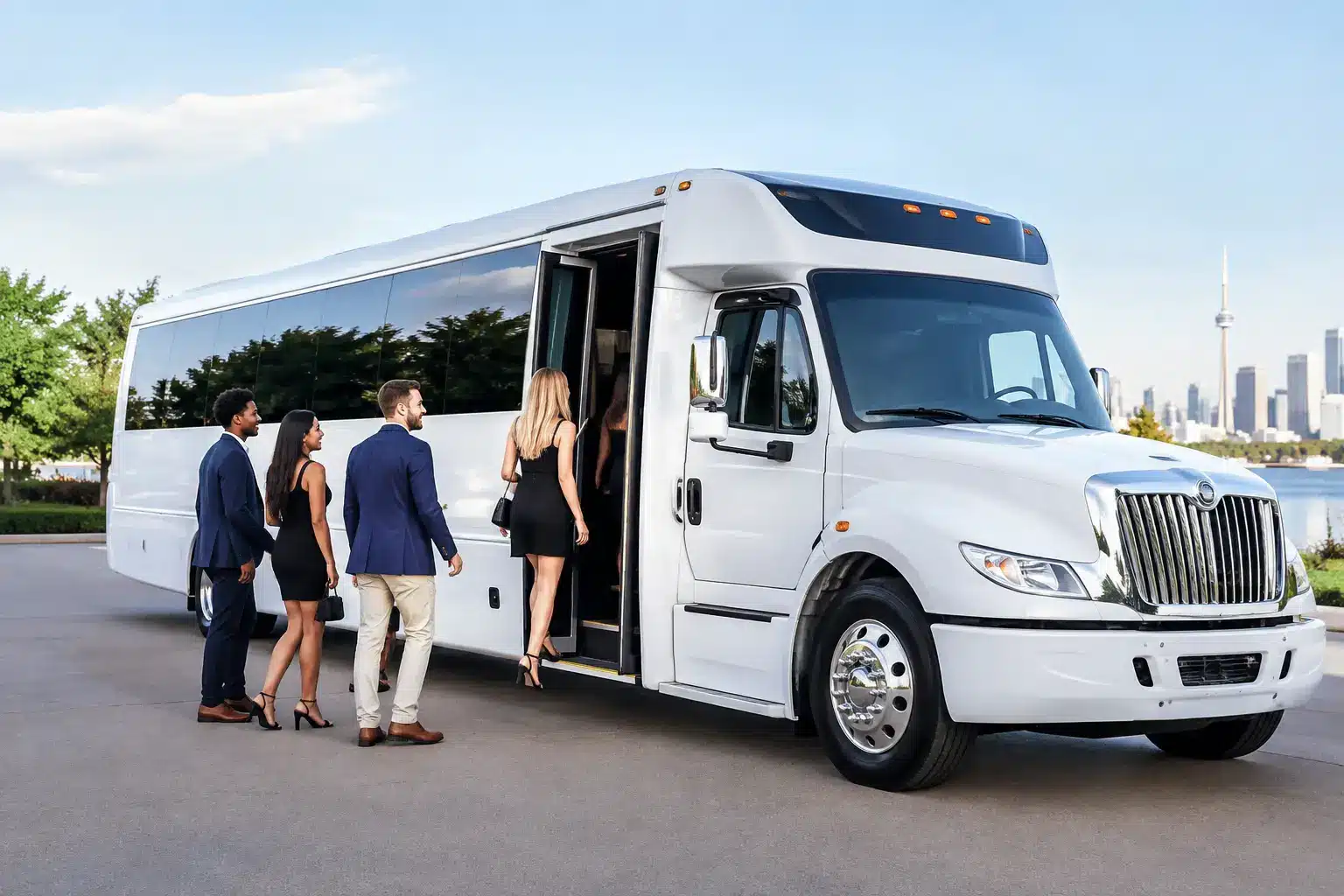
Groups require a different calculation. Assigning several SUVs can work for small delegations, but it can create communication problems when everyone needs to arrive and depart together. A Mercedes Sprinter Corporate seats up to 14 passengers and is built for business groups. The Mercedes Jet Interior Sprinter seats up to seven passengers for a smaller executive delegation, while the Ford Transit provides another 14-passenger option.
For larger meetings, conferences, site visits, and company events, party buses from 22 to 50 passengers and shuttle coaches seating 23, 27, or 56 passengers can keep teams together. The right option depends on whether the group is traveling with presentation equipment, airport luggage, or simply moving between a hotel, office, venue, and dinner reservation.
Keeping a group in one vehicle is not always necessary. Senior leadership may need a separate SUV or sedan while the wider team travels by coach. In that case, a single dispatcher and one shared schedule help the vehicles move as a coordinated group rather than as unrelated bookings.
Airport and Private Aviation Transfers Need Specific Information
Airport transportation is often where incomplete details become expensive. A flight number alone may not be enough. The booking should account for the airport, arrival terminal, passenger count, checked luggage, mobile contact number, and whether travelers are arriving together or on separate flights.
Platinum Rides provides chauffeur service to Toronto Pearson YYZ and Billy Bishop YTZ, as well as Hamilton YHM, Ottawa YOW, Montreal YUL, Buffalo BUF, Detroit DTW, Windsor YQG, and Kingston YGK. For longer business travel, a confirmed flat rate is especially useful because the route is agreed upon before departure rather than priced by the kilometer.
Private aviation requires another layer of coordination. Travelers arriving at Pearson through Skyservice, Signature Aviation, or Skycharter are collected at the FBO terminal, not the commercial arrivals area. The chauffeur and booking team need the aircraft schedule, terminal location, passenger names, and any changes relayed by the flight crew or client contact. An Escalade, Suburban, Rolls-Royce Cullinan, or Maybach S 580 may be appropriate depending on the passenger profile and baggage requirements.
Privacy Is Part of the Service Design
Corporate travelers may be discussing a transaction, personnel matter, legal issue, medical administration, or upcoming announcement. Privacy should be treated as a booking consideration, not an afterthought. Limit shared itinerary details to the people who need them, confirm the authorized contact for changes, and use precise pickup instructions rather than broad descriptions.
For sensitive assignments, NDA-secured booking can be requested. It is also sensible to decide in advance who can add, cancel, or redirect a trip. A clear authorization process prevents last-minute confusion when an executive assistant, traveler, and office coordinator are all communicating at once.
This matters for visiting executives as much as local ones. A guest from a bank, law firm, university, hospital administration, or manufacturing company should not need to explain the schedule repeatedly after arriving in a new city. One complete itinerary, confirmed in advance, is usually more effective than a chain of partial messages.
Build a Repeatable Process for Regular Travel
Companies with recurring transportation needs benefit from a consistent booking process. The goal is not to remove human judgment. It is to make common trips easier to arrange while leaving room for changes in passenger count, flight schedules, and meeting locations.
A useful corporate booking request includes:
- Passenger names and a mobile contact for the day of travel
- Pickup and destination addresses, with requested arrival times
- Flight or FBO information for airport assignments
- Luggage count, passenger count, and any need for multiple vehicles
- Billing contact, purchase order reference, or cost center when required
Corporate accounts with monthly invoicing reduce the need to reconcile individual payments after every transfer. At Platinum Rides, rates are confirmed before departure, plus HST and gratuity, with no per-kilometer charges. That structure can be particularly helpful for finance teams managing recurring executive travel, roadshows, client visits, or travel between Toronto, Hamilton, Guelph, Kitchener-Waterloo, Kingston, Ottawa, and Montreal.
Since 2013, Platinum Rides has grown from one Chrysler 300 to a 27-vehicle chauffeur fleet and has completed more than 500,000 trips across Ontario. That history matters because corporate transportation is built on repeatable execution: understanding building entrances, airport procedures, group movement, and how quickly an itinerary can change.
When Presentation Matters, Be Deliberate
Not every corporate booking needs a statement vehicle. But there are occasions when the vehicle itself supports the purpose of the visit. A Rolls-Royce Ghost or Mercedes-Maybach S 580 may suit an executive dinner, a major client pickup, or a private aviation transfer. The Rolls-Royce Phantom Two-Tone, the only custom-painted model of its kind in the Toronto area, may be appropriate for a high-visibility event where arrival presentation is part of the occasion.
That choice should be deliberate rather than automatic. A visiting engineering team carrying equipment needs capacity more than ceremony. A senior executive arriving for a closed-door meeting may value a quiet sedan over a larger vehicle. Good corporate planning recognizes both priorities without treating every transfer the same way.
The useful question is not simply, “What vehicle should we book?” It is, “What does this group need to accomplish between pickup and arrival?” Once that answer is clear, the vehicle, chauffeur plan, timing, and billing structure become much easier to organize.